


Teaching Methods in Singapore Preschools

Which teaching method best suits your child to reach his full potential?
The Different Types Of Teaching Methods In Singapore
There is an inexhaustive list of teaching methods adopted by Singapore educators to help children achieve the most during their early years. Depending on individual child and parents' preferences, some of these methods are more suitable for your child than others. Choosing a suitable teaching method that best fits your child and your expectations can do wonders in aiding the child to achieve his or her maximum potential. Here are 6 more well known types of teaching methods that can be found in Singapore:
1. The Montessori Approach

The Montessori is an approach designed to leverage on the child's natural thirst for knowledge and behavior and it's where the child is encouraged to explore with his innate learning desires and abilities with minimum assistance. It is a popular teaching method in Singapore but in recent years, due to the increasing pressure to prepare children for primary school education, many centres start to tweak the full montesorri approach to introduce a mix of the Singapore's culture (aka asian parents) where a little structured play and teaching is introduced. Any school can claim that it is adopting a Montessori approach as there are no strict guidelines on this claim. However, in general, a school that encouages this approach is definitely spacious to encourage freedom of movement and exploration, as well as mixed age learnings.
Some Montessori schools in Singapore:
- Brighton Montessori
- Brainy Child Montessori
- Greentree Montessori
- Amazing Star Montessori House
- BabyPlanet Montessori
2. The Reggio Emilia Approach

While this method also focuses on child-directed learning, it also encourages the child to explore what he or she has interest in and the curriculum will be further designed around it. The Reggio Emilia approach believes that children are driven by their own interests to learn more and should be empowered to dictate what they should learn. In class, the teacher will assume the role of an observer, constantly taking down notes, recording every individual child's preferences, behavior and interests so that they can make use of these info in the developing of a customized learning path for the child.
This method empowers the child and can build confidence in him or he. Hence some find it useful for developing patience and resilience in the child, as well as useful skills such as working in groups and collaboration for future challenges.
Some Reggio Emilia Schools in Singapore:
- Blue House Nursery & Intl School
- EtonHouse
- Mulberry Learning Centre
- Hundred Thoughts Preschool
- LeClare Preschool
3. The Kumon Method

Photo courtesy of Kumon
The Kumon method is a personalised and empowering learning method tailored to suit your child’s ability and not his age.
This renown method encourages independent learnings and allows the child to progress at his or her optimal pace and study more advanced topics and concepts beyond his or her school grades.
Besides helping him/her to achieve more academically, the Kumon Method is known for imparting key life skills such as determination, independence and a passion for learning that will enable the child to overcome obstacles in school and beyond.
4. Play Based Approach

Even though the word “play” may be deemed as wasting time in traditional parenting terms, the play based approach allows the child to play and gain cognitive benefits at the same timeas it was built on the belief that children learn best when they are playing! As opposed to a rigid plan in traditional schools, this teaching method has specially-designed activities like dance, cooking and more to keep learning experiences new and fresh for young children.
This method allows the child to learn in a fun and interesting manner so that he or she can learn better when they are stimulated.
Some schools that use the play-based approach in Singapore:
5. Waldorf Steiner Approach

This approach focuses on children learning through sensory experiences and practical activities. It allows children to develop their imagination and creativity by establishing a predictable routine so that they can have a sense of security to think freely.
The child can learn in this approach by self-initiated play. Through sensory experiences, your child can develop a love for learning and an enthusiasm for school.
Some schools that use the Waldorf Steiner approach in Singapore:
6. Theory of Multiple Intelligences

This approach is based on the research and belief that a child’s intelligence is multi-dimensional and has 8 types of intelligences. These include: musical-rhythmic, visual-spatial, verbal-linguistic, logical-mathematical, bodily-kinesthetic, interpersonal, intrapersonal, and naturalistic.
Theory of Multiple Intelligences aims to develop each of the 8 intelligences to its full potential. Hence the child can reach full potential in all his or her abilities by having more attention on the weaker abilities.
Some schools that use the Theory of Multiple Intelligences approach in Singapore:
6. Mandarin Preschools
_1595572977.jpg)
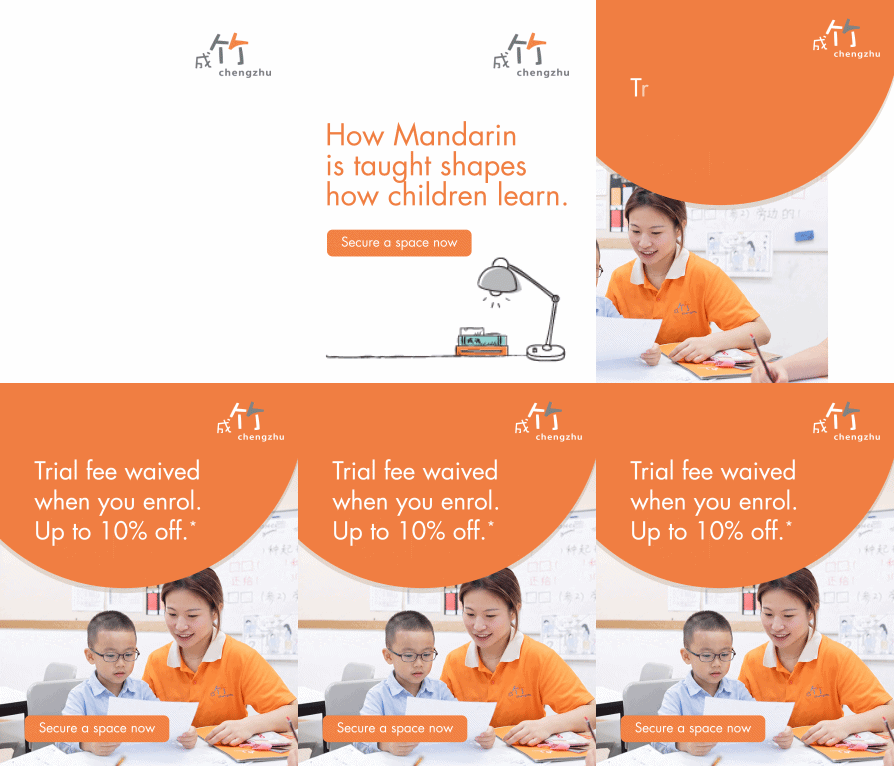
Photo courtesy of Chengzhu Mandarin Centre
A recent news shows that 71 percent of Chinese households with Primary 1 students spoke mainly English as compared to Mandarin at home. Some preschools are going with the Mandarin teaching approach so that the child gets a headstart in bilingualism and gets to be exposed to the language earlier.
Some Mandarin Preschools in Singapore:
There are also preschools that created their own teaching methods such as MindChamps which used their own unique “3-Mind” approach – based on the synthesis of the Champion Mind, the Learning Mind and the Creative Mind. Kidz Meadow also used their own “Nature Magnified” approach which gives children an opportunity to interact with diverse natural elements or Chiltern House which uses their proprietory “EduDrama” methodology that focuses on language, imagination and discovery bringing children into the magnificent worlds of literature, mathematics, science and arts.
With so many types of teaching methods, choosing the one which best suits your child and your parenting preferences will ensure that your child’s learning is steered in the right direction.